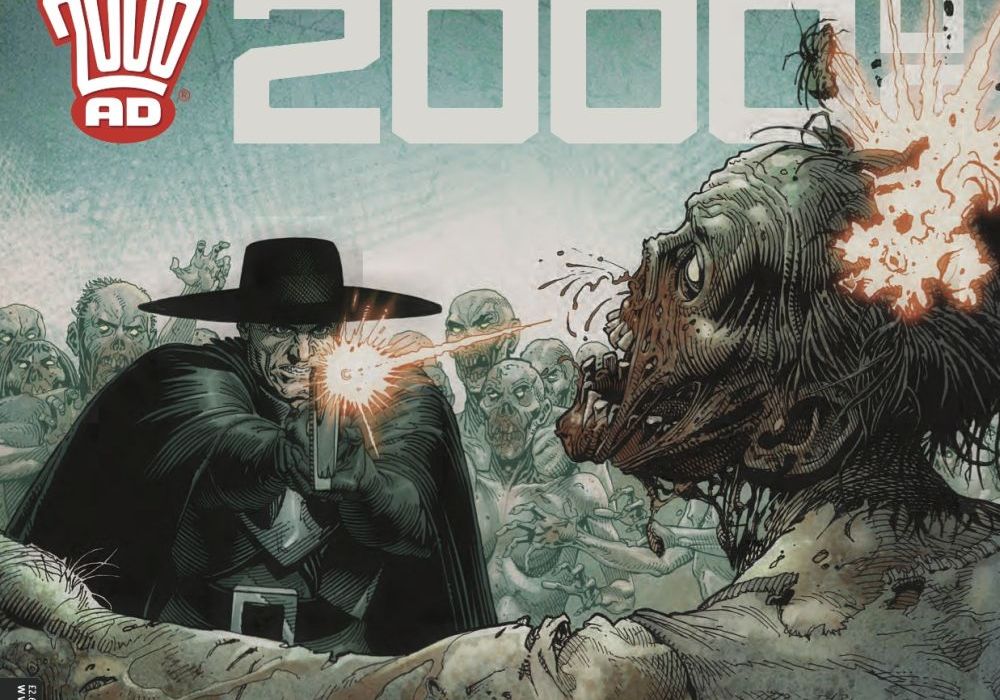

Welcome, Earthlets, to Multiver-City One, our “2000 AD” weekly review column! Every Wednesday we examine the latest offerings from Tharg and the droids over at Rebellion/2000 AD, the galaxy’s leading producers of Thrill-Power entertainment. Let’s get right to it!

Judge Dredd: Harvey, Part 3
Credits: John Wagner (script), John McCrea (art), Mike Spicer (colors), Annie Parkhouse (letters)

Greg Matiasevich: Judge Dredd’s field assessment of the new Mark 8 RV Mechanismo robot — Judge Harvey — continues, with the lawman hard-pressed to find any real fault with the droid judge so far. But when the media shows up at one of the duo’s crime scenes, will the viewing public be able to say the same thing?
We get more of the same thing this week from Wagner and McCrea & Spicer, but when they’ve been doing a good a job as they have since Part 1, I find that to be a reassurance rather than complaint. The only thing more fantastic than how this strip looks is how well Judge Harvey is handling himself under the gaze of Dredd. Even when he’s strayed a bit from Dredd’s well-worn path of judicial comportment, it’s in service of actually ‘serving’ the community they have sworn to ‘protect’: a kind word for an elder cit or a promise of witness relocation to Texas City for a perp to turn witness. For all his imposing McCrea-rendered visuals, purposefully designed by Mega-City One (and original artist Colin MacNeil) as a Judge Dredd visual to the extreme (complete with exo-chin) for maximum intimidation, Judge Harvey is clearly the good cop of the twosome.
Wagner does such a good job with making Harvey likable that, like I said last week, you KNOW there’s going to be a heel turn. Or at the very least, a huge twist at some point. The advantage that Wagner has with having his co-creation handled by 2000 AD is that he has the benefit of time in letting stories either flashbang or slowly simmer. So that dramatic twist we all know is coming doesn’t have to come in 8 weeks or 8 months, or even 8 years, frankly.
He has time (for example) to let Harvey pass with flying colors and then either introduce a personality shift in Harvey later on, or have some problem manifest in the Mark 8’s coming after him. Because remember, Harvey is not a unique one-off or anomaly. Judge Hershey named at least three other units (George, Bernard, and Clarice) back in Prog 2024, and the whole idea of the reviving the Mechanismo program was to supplement the dwindling pool of available Judges. Can all of these nuances and responses programmed into Harvey be replicated as well in the other Mark 8s? How much of that personality Wagner is using to win over readers (if not Harvey’s overseer) IS unique to Harvey? We’ll find out soon…I hope!
Defoe: Diehards, Part 1
Credits: Pat Mills (script), Colin MacNeil (art), Ellie de Ville (letters)

Ryan Perry: Colin MacNeil really kills it on “Dafoe: Diehards;” from the very first image, the reader’s attention is held by the throat. His style, which is reminiscent of a child’s collection of scary stories, establishes a distinct tone and mood for the story. His panel structure builds a story that drags the reader along with it, while being truly inventive at times. The art’s murky feeling creates a believable atmosphere for something horrific to happen. “Dafoe” wouldn’t be the same without the black and white color palette, which evokes the black and white morality that would’ve been present in this time period, due to a stricter accordance with religious or governmental guidelines. The only issue with the art is that sometimes the cartoon-like depiction of characters can clash with the environment around them, the tone, or the story being told.
The story Pat Mills tells here is really interesting, though it’s often betrayed by cookie-cutter dialogue or unrealistic character interactions. The plot is set up fine, but the reader is never truly endeared to the main characters, which makes it hard to care for their plight. The chosen names for many of the things in this story don’t read right. “The Diehards” sounds more like an ’80s action movie than a scary story in the 1800s and “reeks” sound more like a science-fiction monster you’d find in a “Future Shocks” story than an old-timey monster. While the story here is really interesting, it’s truly the art that carried this issue.
Continued belowBrink: Skeleton Life, Part 4
Credits: Dan Abnett (script), INJ Culbard (art), Simon Bowland (letters)

Alice W. Castle: In this chapter, Abnett and Culbard continue to drip feed the audience information, introducing another new face and starting Kurtis down a path that could lead to a possible explanation for the ghost stories plaguing the Galina Habitat. Unlike the last chapter, Abnett and Culbard use all five pages on the one scene as Kurtis meets the real head of security on Galina Habitat and they butt heads somewhat. Abnett does a good job of building the tension in the dialogue, showing their interaction as testy, but professional. Neither fly off the handle, but there’s an underlying tension between the two that seems fit to boil to the surface over the course of the story.
The downside to this being a chapter that is focused on one scene of two people talking is that it doesn’t really give INJ Culbard much to do artistically. As I’ve stated previously, Culbard’s layouts are fantastic and his use of blocking in panels brings that tension between Kurtis and Gentry, the head of security, to the fore. Culbard continually blocks panels so that Gentry towers over Kurtis, even having panels where Gentry’s shoulders cover most of Kurtis’s face. As the story goes on, however, Culbard gradually brings them more in line until they’re eye level with one another once a fragile sort of understanding is reached.
Culbard is putting on a masterclass in how to frame and block panels in dialogue scenes. I just wish that Abnett would keep up. The slow pace of this story is really dragging it down for this format. If they had more wiggle room and were able to connect these scenes in a larger issue maybe it would work, but these bite sized chunks need a bit more oomph than we’ve been getting. Disappointing after how stellar the opening chapter was.
Scarlet Traces: Cold War – Book Two, Part 4
Credits: Ian Edginton (script), D’Israeli (art), Annie Parkhouse (letters)

Rowan Grover: “Scarlet Traces” takes an introspective, surreal look at how the Martians came to be in Part 4. Edginton writes a punchy script that’s descriptive, but with terms and language that don’t make it overwhelming. He pens a poignant metaphor in comparing the Martians to a mother, the Mentat saying that they “will do anything to protect them, justify the darkest acts.” It’s a great character arc for Ahron as he realises that he’ll have to commit an unspeakable act for the greater good, and wrestles with this idea.
D’Isreali delivers great psychedelic mindscapes, feeling reminiscent of old Brendan McCarthy art in 2000AD. The second page is immediately distinguishable thanks to this, with a spiral of unique looking planets connected by a thin purple line dazzling the entire page. But as usual, there’s great softer moments to contrast this. D’Israeli draws a slightly voyeuristic moment as Ahron and the Mentat watch a Martian family playing together, directly opposing the common perception of them. It’s not only a great moment, but a subtle racial commentary, and a great way to advance the plot.
As always, “Scarlet Traces” continues to be full of intrigue. Edginton and D’Israeli dial back the action this issue to give us a lesson on Martian culture, but one that’s fun and not overly preachy.
Cursed: The Fall of Deadworld, Part 4
Credits: Kek-W (script), Dave Kendall (art), Annie Parkhouse (letters)

Greg Lincoln: Last week, we discovered that the old Chief Judge’s bunker, a place of safety, supplies, and air-con, was not all that secure, and possibly not all that secret. The sanctuary proved to be already occupied by a group of at least a dozen people who appear all too prepared and equipped to defend themselves. Their appearance opens up the view of the wider world revealing a resistance movement; people armed with weapons and advanced technology that may make a difference. It is an odd impression, since we know things go terribly wrong on Deadworld. This issue brings back the Judge Cloud, as one of the assailants hacks it. It was mentioned in the first issue as Fairfax had removed Byke from to prevent tracking, a plot point that could open more than one door.
Continued belowAnd no issue of “Cursed” would be complete without a reminder of Sidney Death, the dark specter hanging over the story. This time, we get another flashback to his cruelty to Fairfax when he flashes back to his tutor engaging in an object lesson worthy of a David Cronenberg body-horror movie like Dead Ringers. Giving us snippets of Fairfax’s memories reminds us that even far away, Death’s presence is still felt; there is always disaster lurking just round the corner.
Dave Kendall used his careful attention to realistic detail in this issue, delivering pages of very well defined characters, especially compared to last issue. He did more to define the women who attack Jess and Fairfax through their appearance than the script did, particularly for the intricately tattooed woman carrying the bow. With his style of art, it could be hard to define motion, but Kendall did so effectively in Byke’s fight, which ended all too fast in the opening panels. Through the flashback, he continued his use of deep shadows to set a foreboding tone of what was to come. I have never seen a common set of dinnerware look more threatening.
That’s gonna do it for us this week! “2000 AD” Prog 2026 is on sale this week and available from:
- The 2000 AD Newsstand app for iPad and iPhone,
- The 2000 AD app for Android devices,
- 2000ADonline.com in print or DRM-free PDF and CBZ formats, and
- Finer comic shops everywhere
So as Tharg the Mighty himself would say, “Splundig vur thrigg!”


