 |
| Casanova Quinn — Multiversal Man of Mystery |
In today’s (a little bit late) Off The Cape, we turn on a good CD you’ve never heard of (nor have we, technically) and talk about what it’s like to hop through time and space.
Or — well, something along those lines, anyway. More after the cut.
I would never say that I’m not an absolute fan of the superhero genre, because I am. I adore comics with capes and tights and, as long as I’m reading comics, I will probably read at least one title featuring someone in spandex; this is an inscapable fact of life that I have long since learned to live with and not pretend to fight.
 |
| Casanova: Avaritia #1 |
However, if there is one thing that generally irks me about the world of mainstream comics, it’s that they’re generally not doing anything substantially new for the medium. Not to go on a rant or appear to be against an entire genre, but more often than not a capes and tights book will be more about telling a good story than it will be fully utilizing a comic’s capabilities. We won’t see a book that actively attempts to break the boundaries of a comic book’s average capability, or even realistically try to redefine storytelling techniques (outside of a few examples here or there), and that’s a little bit sad. These stories are 50+ years old and growing more every week/month, but very little are trying to do anything beyond just keep the story and/or character going.
To keep the comparisons in house, so to say, look at Marvel’s big event title. A book like Fear Itself is a book that isn’t trying to reinvent comics because that’s not the point; Fear Itself’s goal is to tell a good summer blockbuster event book with two of Marvel’s top talents at the helm, and everyone else generally crossing their fingers that people will like it and that the story will leave some kind of impact on the ever expanding history of superheroes. No wheel re-invention here, just greasin’ up the one that still works and rolling it down the hill. This doesn’t make it inherently bad or anything like that, it just means that the book is going to come and go as a major blip on the Avengers timeline, but years from now no future writer is going to say something like, “Yeah, I was greatly inspired by this one scene where the Thing smashed a hammer really hard.” (I imagine if Fear Itself had a Facebook status, it’d be something like “Fear Itself is.”
This is why a comic book like Casanova, written by the writer of Marvel’s Fear Itself both long before and at the same time as Fear Itself was even an inkling of a thought, is so damn important.
Beginning in 2006, Casanova exploded onto the scene (in a bit of a quiet riot, to be truthful) from Image. Starring the adventures of super-spy/thief Casanova Quinn, the poor guy found himself wrapped up in a multi-dimensional game of chess between two opposing organizations, E.M.P.I.R.E. and W.A.S.T.E. Casanova lasted for 14 slimline issues (16 larger pages for $1.99 each) split evenly as two “albums” (aka volumes) before Fraction was pulled away circa 2008 for his Marvel work and Iron Man, while Ba and Moon went on to work on the critically celebrated Umbrella Academy and Daytripper. Casanova was always going to come back, it was just a question of when (like in the comic!).
Returning last year, Casanova came back from Marvel’s Icon in reprinted/re-colored issues combining two slimline books per floppy and jam-packed with desnly written back-ups. The releases consisted of two four-issue minis (Luxuria and Gula) with only one changed line in the entirety of the comic. With the title now able to reach a much larger audience given Fraction’s high profile status, there was much celebration and panda slaughtering. Now, in 2011, the first new Casanova comic in 3 years is released, and the world is definitely better for it.
Continued belowYou might be, at this time, asking yourself why I am insiting Casanova is an important comic book without giving the slightest bit of evidence. The easiest way I can defend my argument is simply to pass on a copy of the book, but given that that doesn’t look like a likely option, I will say this: Casanova is one of few books to literally attempt to do something with it’s space in the medium. While the rest of Fraction’s work is fairly easy to follow in its execution, Casanova instead occupies its own space, showing off a story that simply could not be told in any other medium, nor should it (not to admonish his other titles or anything; I am a fan of his superhero work as well). You can’t/won’t see Casanova in any other form of media (not done well, anyway), and I doubt you’ll see anything quite like this in a superhero comic that doesn’t have Grant Morrison or Joe Casey’s name on it. Casanova has made its bed in comics, and it is there that it will lie, set and ready to start a comic revolution.
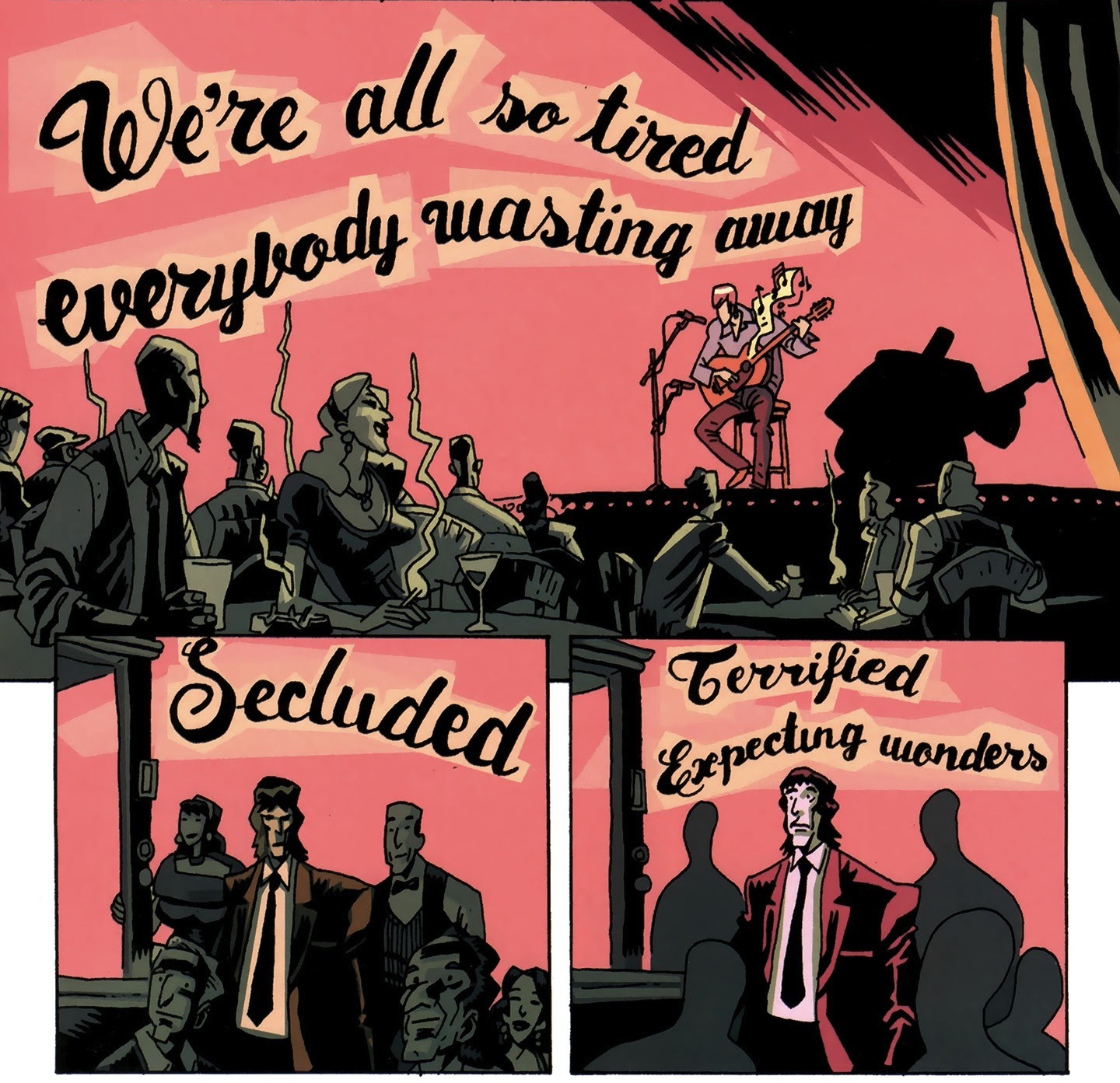
It is quite appropriate that Casanova the character explores space and time as in general that seems to be the modus operandi of Casanova the book. The sort of basic plot of the book (excluding a look at its themes) is that we have a character who is charged with traveling between universes to accomplish tasks of multiversal importance. Given the shifting nature of that aspect of the book, it ostensibly calls rather heavily on the creative team to uniquely illustrate these shifts in the nature of the title. How fortunate, then, that both Fraction and Ba/Moon use any given page of Casanova to play the book like an instrument, and — given the heavy influence of music on the comic that is readily apparent (Casanova frequently references both existant and non-existant music) — the underlying musical qualities of the book stand above even the most overtly musical of comics (i.e. Phonogram).
 |
| Casanova: Avaritia #1 |
Instead of referring to arcs or volumes of Casanova as “arcs” or “volumes”, Fraction has referred to the stories of Fraction as albums. Music has always been an important aspect of not only how we perceive reality around us but also how we intake apsects of our own lives, and its influence can be strongly felt just about everywhere, with Casanova being no exception. In an abbreviated nutshell, Casanova is the concept album Fraction would release with his band if he were a musician instead of a comic bookwriter. Quietly inserting himself into the comic in the now-overt form of Luther Desmond Diamond, Fraction plays with dialogue and story bits to an unheard tune that is actually referenced in the book, giving the title its own time signature of sorts that results in a rather unique reading of a comic.
 |
| Casanova: Avaritia #1 |
Casanova is also a rather stark tribute to comics and the medium as a whole. While to an extent the book sort of reads like Fraction spent far too much time browsing Wikipedia and writing down things he thought was cool (a point brought up by fellow staff writer Patrick Tobin), it stands as noteworthy that Fraction is using his time with Casanova to essentially fill it to the brim with the things that he loves and the things that work best in comic books. In our age there has been a rather tremendous upswing in the idea that any comic book can be taken and adapted for another venue, with most examples not proving that hypothesis true. Casanova, in so many words, essentially proves beyond a shadow of a doubt that there are some things that a comic could do that a film never could; for example, Casanova: Avaritia #1 (out last month) found Casanova hopping through multiverses attempting to find and snuff his greatest mortal enemy out of existence, living thousands of different lives in the blink of an eye or the turn of a page, all of which is beautifully illustrated and plotted by the creative team of the book (see image to the right) to spread his spatiotemporal adventures out among the page. If there ever was a perfect example of ideas spread out against the capabilities of a medium and what it can offer, this one page alone speaks volumes.
Continued belowSo, to re-iterate: Casanova is a concept album in the form of a comic (instead of, say, a concept album adapted into a comic) in which the writer not only fills the book with everything he clearly loves about genrestorytelling, but also exists within the pages to antagonize the main character in a series of increasingly exhilerating action. Add to that the aforementioned back-up material, featuring essays and interviews by Matt Fraction, and you have a potent mix of music, life and sequential art that could prove deadly to some.
While Fraction assembles and dismantles the universe, artists Gabriel Ba and Fabio Moon in the span of 8 issues (or 18 slimlines) use their talents to deconstruct our preconceived notions of space within the constrictions of the comic book medium. Your average book can be rather easily read through regular sequential panels, but Ba and Moon — no strangers to medium deconstruction — present the world(s) of Casanova to us in a stylized and beautifuly rendered variety of Kirby-esque pop art and broken down panels featuring visually infinite creativity. Whether it is the above example of Casanova fighting for his life betwixt universes in between spatiotemporal apocalypses, or even pages and panels illustrated from the point of view of Casanova’s mind involving his warped perceptions of reality, Ba and Moon challenge the reader to truly absorb the art of the comic. If we are to resound to the fact that the average length it takes to read a comic is around 15 minutes, Ba and Moon’s work in Casanova on average demands the same amount of time be given to any given page of the book, let alone the entire ordeal. It is easily one of the best looking books month in and month out.
 |
| Casanova: Avaritia #1 |
To a certain extent, it’s a bit tough to write about this title with a grand sense of clarity. On the one hand, I’d rather like to avoid sounding like a rambling lunatic fanboy frothing at the mouth and stammering to create a cohesive thought. On the other hand, this comic is just so fucking cool. That is, in a nutshell, the divide that my mind is taking on presenting the title to you: while I’d like to explain in words what it is that I believe makes Casanova truly tick, I know I’m coming up short. (Maybe I’m just an idiot and a poor writer, but let us pretend that is not the case for now). This is instead just one of those comics that is better off seen and personally absorbed in order to be assessed properly, to be truly enjoyed and digested. My only recommendation is to put some money aside or drop a few titles so that you can get your $4.99 copy of Casanova every month as it comes out, because this is what comics are all about.


