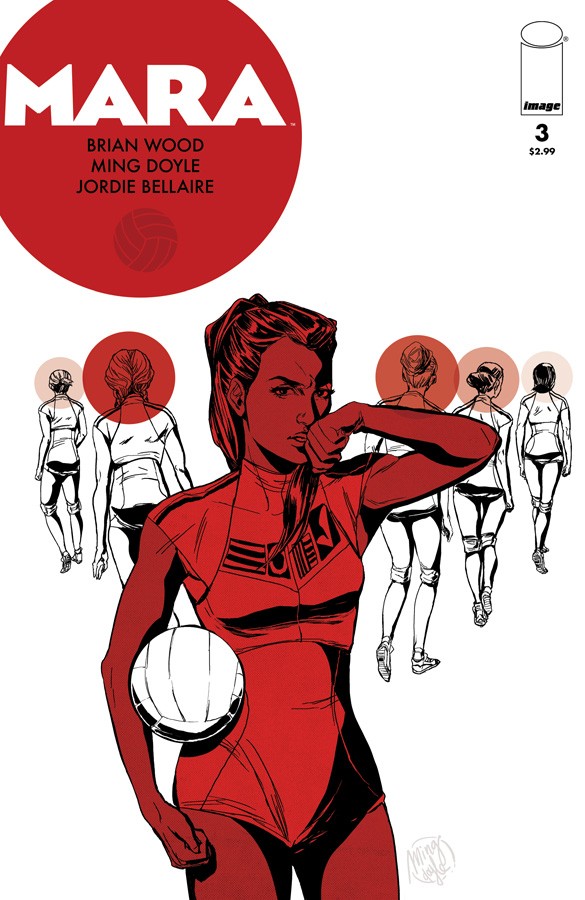
While I love both Brian Wood and Ming Doyle’s work, the first issue of “Mara” did not quite sell me. Still, I stuck around for the second, and was much more impressed by what I saw. As we reach the halfway point, is the team behind the volleyball playing super-lady able to completely tip the scales and nab me for the long haul?

Written by Brian Wood
Illustrated by Ming Doyle and Jordie BellaireSeeing her friends and supporters abandon her, and instead of trying to suppress her newfound powers, Mara goes public. Openly displaying her rapidly developing abilities, she challenges the bias and discrimination. People start to see her as not a freak, but rather someone who can’t be stopped, and that starts to make a lot of very serious people very concerned. Socially-aware superheroics in a world we’ve never seen. Brian Wood, Ming Doyle, and Jordie Bellaire bring the goods.
On the surface level, this third issue is a pretty standard stepping stone on the path of the budding superhero. At this point, Mara knows there is something different about her — besides, you know, being a superstar volleyball player — but the extent of that difference is still vague. In other ways, though, Mara’s “Secret origin” is significantly different than many other superpowered characters (one hesitates to call her a superhero just yet). Even the most famous outed “celebrity” heroes tend to have at least a moment of privacy before deciding to make their powers public. Mara, on the other hand, does not have that kind of luxury; she learns of her potential in the same instant as the rest of the world. It is in this regard that Wood finds his own unique suspension of disbelief anchor, if that makes any sense; we know, these days, that high profile athletes of Mara’s caliber are never unmonitored. We can excuse the flying, we can excuse the bullet-proof skin, but if Mara somehow had these changes happen to her without someone knowing, Wood would completely lose us. Whether he’s dropping bombs on Manhattan, flying through space in an X-Wing, or playing volleyball with a superpowered starlet, Wood has always had an eye for the tiny details that sell a book, no matter how fantastical the premise, and this twist on the old-as-the-medium super-person origin story is a great example of that talent.
We also see this eye for the fine details mix with Wood’s knack for characterization in this issue. Another staple of the newly super-powered protagonist is the period of growing pains. When Peter Parker wakes up the day after being bitten by a radioactive spider, he finds himself accidentally knocking bullies out, sticking to things he souldn’t, and generally acting very, very, jumpy. When Mara, a professional athlete since she was a child, finds herself in a similar position, the transition is a bit smoother. As the previous two issues have shown, Mara’s conditioning has made her confident and, in rare, flight-inducing instances, controlled. When she finds herself with unbelievable powers and, semi-spoilers, under the gun of the law, she doesn’t freak out: she inhales, exhales, and adapts. It wouldn’t make sense with most superpowered characters, but then again, who are most superheroes in their “secret identities?” Nerds. Farm boys. The shy girl who has trouble asking her secret admiree if he or she would like to hang out. In other words, complete opposites from Mara. Conversely, it would seem strange to see Mara bumbling about; were the first two issues we read lying to us about this confident young woman? Wood is sure not to overdo it, though; careful care is taken to make sure that we are merely seeing how powerful Mara’s “set” is, rather than seeing a newfound super attaining instant mastery.
Wood has had the luxury of working with some of the most talented artists in the industry, and on a list of incredibly capable illustrators, Ming Doyle is near the top. Her figure drawing has such a studied look to it, without being shackled to tradition. Her clean, sparse linework allows for ease of reading, and effectively conveys emotion. Mara’s phone conversation is a great example of this: these are two pages of a single character in a rather flat environment talking to someone who can be neither seen nor “heard,” and yet Doyle makes it just as… well, almost as captivating as the dynamic chase scene that follows immediately. The only real objective complaint one can file against Doyle’s work in this issue is the frequent use of blank, or at least significantly empty, backgrounds. It is, of course, part of her style — it wouldn’t be Doyle if her backgrounds were messy with clutter unless the script called for it — but it does cause some panels to lose their luster. Thankfully, she has colorist extraordinaire Jordie Bellaire, who is able to further round out panels that might otherwise be so sparse as to be flat. Speaking of Bellaire, the pallete she has chosen for this book looks like nothing else out theses days: bright and vibrant, but not at all abrasive or generally in-your-face.
In some ways, this is the most super-heroic issue of “Mara” yet, but only in how Brian Wood and Ming Doyle have made their own unique version of the comic origin story. From its announcement, it was clear that this had the potential to be something both familiar and yet different, and with this issue the book has really hit its stride. Both Wood and Doyle seem significantly more comfortable with where they are than in the first issue, and the issue’s final page promises to take this mini to areas of further ethical complications. Mara may be just now realizing her potential, but these two collaborators have fully actualized theirs.
Final Verdict: 8.4 – Not quite Pick of the Week, but damn close.


